Bartók — Sonatas
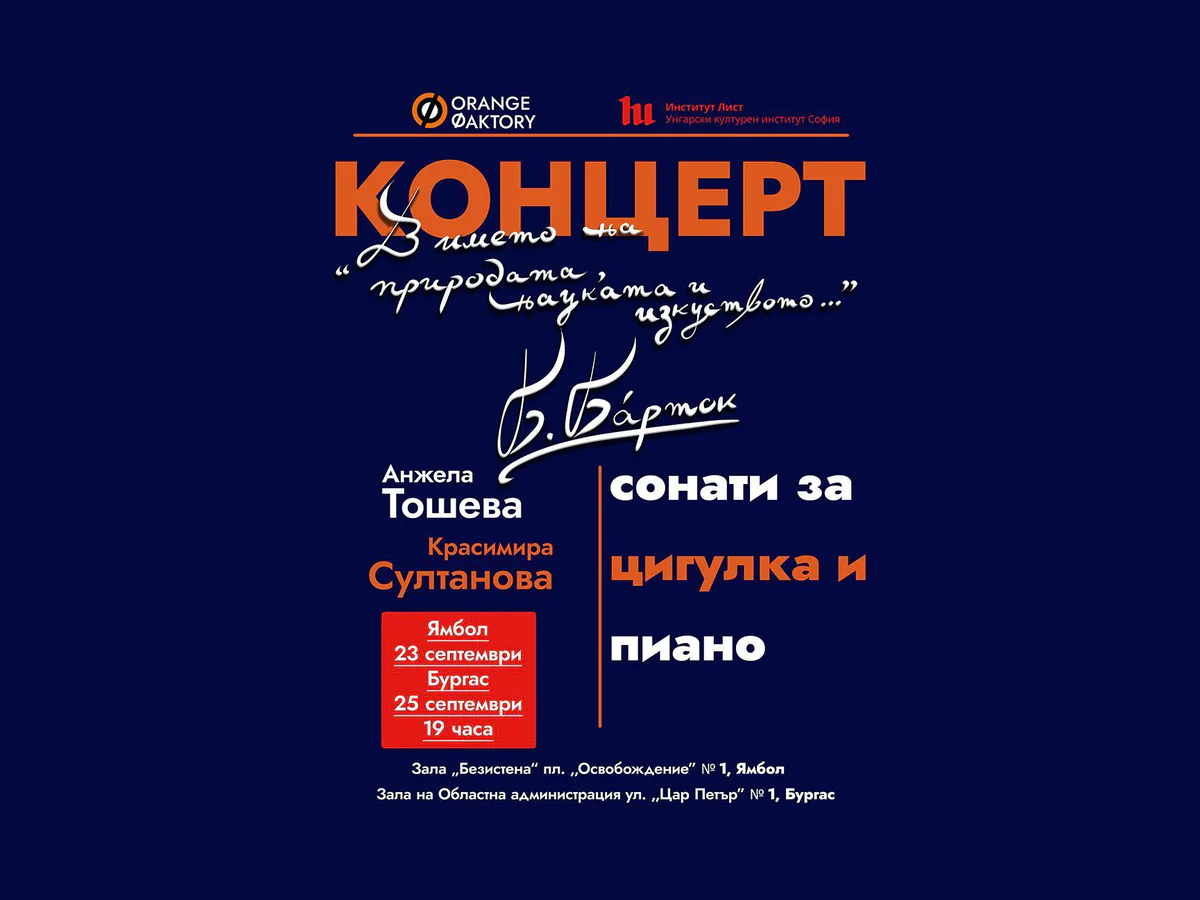
Béla Bartók’s Sonatas for Violin and Piano No. 1 and No. 2, performed by Angela Tosheva and Krasimira Sultanova.

Angela Tosheva (piano) and Krasimira Sultanova (violin) perform Béla Bartók’s two sonatas for violin and piano in the Great Hall of the Regional Administration of Burgas, 1 Tsar Petar Street. Starts at 19:00, free entry.
Programme
- Bartók – Sonata for Violin and Piano No. 1, Sz. 75, BB 84 (1921)
- Bartók – Sonata for Violin and Piano No. 2, Sz. 76, BB 85 (1922)
Bartók’s two sonatas for violin and piano are masterpieces, written at almost the same time as Boulez, Berio and Boucourechliev were born. These works are more than a century old, yet they sound no less abstract, avant-garde and mystical than some masterful new works, and they never fail to touch every listener.
Performers
One of the most distinguished representatives of Bulgarian pianism was born in Sofia. Angela Tosheva received her musical education under the guidance of the teachers Lyudmila Stoyanova, Prof. Mara Petkova, Prof. Bogomil Starshenov and Prof. Lili Atanasova, as well as with the Hungarian specialist Prof. György Sebők and the Norwegian harpsichordist Prof. Ketil Haugsand.
Her mastery as an interpreter and her fine artistic sensitivity are highly valued in Bulgaria and abroad: she has received numerous distinctions from prestigious music events, such as the competitions in Salerno (1978) and Ústí nad Labem (1973), the “Liszt-Bartók” competition (1988), the “Golden Feather” award of Classic FM Radio (1997), the “Chopin” award of the Polish Cultural Institute in Bulgaria (2010), an award of the Bulgarian Salon of Arts, together with Mihail Goleminov, for the multimedia installation “Schumann-Oracle” and the series of concerts marking 200 years since Schumann’s birth (2010), and the “Silver Cross” on the occasion of Hungary’s national holiday and for spreading Hungarian music beyond Hungary’s borders (2019).
Krasimira Sultanova is a virtuoso violinist. She was born in Yambol. Her whole family is connected with music and the arts. Her father, Nikolai Sultanov, a violinist and conductor, is the founder of the chamber orchestra in Yambol; her mother is a cellist, and her brother is the opera singer Georgi Sultanov. Her grandfather is the actor Petar Slabakov, beloved by generations of Bulgarians. At the age of nine, Krasimira Sultanova entered the music school in Burgas. She continued at the music school in Sofia, and at eighteen she was already studying in Germany, in the violin master class of Prof. Rosa Fain, a student of David Oistrakh.
Today Krasimira Sultanova is the first violin of the “Dianopolis” Chamber Orchestra – Yambol, but she also often appears as a guest with major European orchestras.
About the composer
Béla Bartók (1881 – 1945) was a Hungarian composer, pianist and researcher of folk music. He wrote the epoch-making piano piece “Allegro barbaro”, the opera “Bluebeard’s Castle”, which marked the beginning of modern Hungarian opera, six string quartets regarded as classics of modern music, and the late orchestral “Concerto”. He studied at the Hungarian State Royal Academy of Music in Budapest, and in 1907 he was appointed a teacher of performing musicians. Alongside teaching, he supported himself and his family mainly through concert performances. He played regularly in the major cities of Europe and travelled as far as the United States and the Soviet Union. His fortieth birthday was celebrated by specialist journals in Vienna and Paris. On his fiftieth birthday, in 1931, he was awarded the French Legion of Honour, and in Hungary the “Corvin Wreath”. For his collections of folk songs he twice received Romanian honours (“Bene merenti” and “Meritul cultural”).
Thanks to his scholarly work, collecting Hungarian and minority (Romanian, Ruthenian, Serbian, Slovak) songs in the period 1906 – 1918, Bartók is regarded as the greatest, world-renowned authority on Eastern European folk music. He also collected Arab music in Algeria and later Anatolian Turkish folk music in Turkey. In recognition of his work in ethnomusicology, he was elected a member of the Hungarian Academy of Sciences in 1935. His orchestral work “Music for Strings, Percussion and Celesta” (1936) brought him worldwide fame.
Because of the Second World War, in 1940 he left for the United States with his wife. His works place him alongside the two best-known musical innovators of the era, Arnold Schoenberg and Igor Stravinsky. Bartók’s works for children are unique in their pedagogical and artistic value.
On the map
How to get here by bus
The nearest public transport stops and the lines that call at them.
- Tsar PetarЦ2А20 mLines: 992NT1
- Transportna bolnitsaЦ2Б90 mLines: 11178819B11
- Terminal YugЦ7А210 mLines: 882B11B12
- Terminal Yug7A220 mLines: B1B2